SYMPLE UTILITY / 02

Japan to NZ
Import Guide.

A practical path from finding a car in Japan to getting New Zealand plates on it.

Start here before bidding. Import eligibility, paperwork and shipping choices should be confirmed before money changes hands. A cheap car that cannot be certified in New Zealand is not a bargain.

WHERE TO FIND CARS

Auctions, dealers and private sellers.

For most private NZ buyers, the realistic options are public dealer listings, exporter stock, or using an auction agent. Japanese trade auction networks exist, but you normally cannot buy from them directly.

ALL-IN-ONE STOCK AND EXPORT SERVICES

THE FULL PATH

Eight steps to NZ plates.

Do the checks in order. Eligibility and documents are hardest to fix after the vehicle has already been purchased or shipped.

01

Check NZ eligibility

Confirm the exact model code, chassis number, build date, emissions, frontal-impact and ESC requirements with NZTA guidance or an entry certifier.

02

Inspect the listing

Read the full auction sheet and inspector comments, check the chassis number, request extra photos and confirm recall status.

03

Buy the vehicle

Agree on the purchase price, exporter or auction-agent fees, inland transport, storage, inspection, cleaning and payment terms in writing.

04

Deregister for export

The Japanese agent must arrange deregistration for export and obtain the original Export Certificate. Do not accept recycling paperwork as a substitute.

05

Prepare and ship

Arrange inland transport, cleaning, export processing, marine insurance and RORO or container shipping. Retain every invoice.

06

Clear the NZ border

Your broker or freight forwarder handles Customs and MPI clearance using the purchase, ownership, freight and shipping documents.

07

Complete SIV if needed

Prepare evidence early, but lodge the Special Interest Vehicle application after the vehicle has arrived at the NZ port and before entry certification.

08

Comply and register

Send the vehicle and original documents to an entry certifier. Repair any faults, complete certification, obtain a WoF, register and fit NZ plates.

An unlisted emissions code does not automatically mean the vehicle cannot comply. If the Japanese emissions prefix or model code is not on NZTA’s list, compliance may still be proven using other approved evidence, such as a statement of compliance, an appropriate compliance plate, or evidence from independent testing carried out to the requirements of an approved vehicle standard. A normal tailpipe test alone is not enough. Confirm the evidence pathway with an entry certifier or NZTA before purchasing the vehicle. Read NZTA Technical Bulletin 28 ↗

BUYING SMART

How to read an auction sheet.

An auction grade is only a summary. The inspector notes, damage map, photos and chassis details matter more than the headline number.

Identity block

Match the chassis number, model code, first-registration year, engine size, transmission and trim with the vehicle being offered. Japanese registration year is not always the manufacturing year.

Inspector comments

Get a human translation. Look for warning lights, smoke, oil or coolant leaks, corrosion, flood signs, modified structure, missing parts, unusual noises and odometer comments.

Interior and exterior grades

These are separate from the overall auction grade. A high overall grade can still have worn trim, odours, stains, paint defects or underbody corrosion.

Damage diagram

Letters mark the defect type and numbers usually indicate severity. Codes vary between auction houses, so use the legend printed on that sheet.

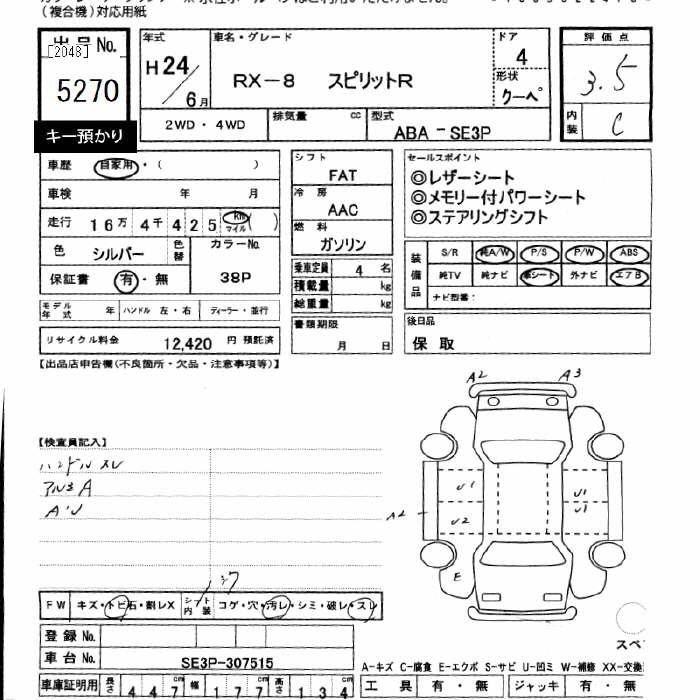
Japanese auction sheet for a 2012 Mazda RX-8 Spirit R Open full size ↗

WORKED EXAMPLE

2012 Mazda RX-8 Spirit R

Registration
H24 / 6 — June 2012
Model
ABA-SE3P
Overall grade
3.5
Interior grade
C
Odometer
164,425 km
Transmission
FAT — automatic

The body diagram marks condition notes such as A2 and A3 scratches. Always translate the handwritten inspector comments and confirm the chassis number before bidding.

4.5–5Typically excellent or near-new, but still inspect the notes.
4Generally good used condition with minor defects.
3–3.5More visible wear, repairs or maintenance risk.
R / RARepaired accident history. Certification risk needs extra checking.
AScratch
UDent
WRepair mark or panel wave
X / XXNeeds replacement / replaced panel
SRust
CCorrosion
YCrack or split
GGlass chip or damage
Do not buy from the grade alone. Ask for the original sheet, translation, current photos, underbody images and a chassis-number check. Auction houses use different grading systems and symbols.

DOCUMENT CHECKLIST

Keep the paper trail complete.

Names can vary between agents and shipping lines. Keep originals, clear scans and proof of every payment. Entry certification may require original documents.

PURCHASE / JAPAN

Proof of vehicle and ownership

  • Purchase invoice or bill of sale showing buyer, seller, vehicle and price
  • Original auction sheet and a reliable English translation
  • Chassis number and model-code confirmation
  • Proof of payment
  • Odometer inspection or verification documents where supplied
  • Pre-export inspection, cleaning or heat-treatment records where applicable
CRITICAL JAPANESE PAPER

Export Certificate

  • Original Japanese Export Certificate / Certificate of Deregistration for Export
  • Accurate English translation
  • Vehicle details must match the chassis plate and invoice
  • This must be export deregistration — not a recycling or scrapping certificate
The original export certificate is one of the most important documents for NZ entry certification. Arrange secure delivery of the original paper, not only a scan.
SHIPPING

Freight documents

  • Bill of Lading or sea waybill
  • Arrival notice
  • Transport or shipping-company invoice
  • Freight and marine-insurance invoice or certificate
  • Japan inland-transport and port-processing invoices
  • Container packing list when containerised
NEW ZEALAND

Border and compliance file

  • NZ Customs Number for imports valued above NZ$1,000
  • Customs import entry and release
  • MPI biosecurity clearance
  • Importer identification and contact details
  • Evidence of ownership
  • Standards evidence requested by the entry certifier
  • SIV permit, repair certification or other exemption evidence when applicable

SPECIAL INTEREST VEHICLES (OPTIONAL)

SIV, a pathway for collector and high-performance cars.

A Special Interest Vehicle permit can provide an exception for an eligible vehicle that does not meet New Zealand's frontal-impact, exhaust-emissions and/or electronic-stability-control requirements. It can be especially useful for collector and high-performance cars that are not yet old enough to qualify for the 20-year exemptions, provided the vehicle and applicant meet the SIV criteria.

Vehicle qualifying criteria

NZTA must consider that the vehicle will be owned as a collector's item. It must either have historic value, or evidence must show that it meets at least three of these four criteria:

  • The make, model or sub-model is identified as a collector's item in a qualifying commercially produced motoring publication or website
  • The make and model had annual production of 20,000 vehicles or fewer
  • It was manufactured as a two-door coupe or convertible
  • It was manufactured as a high-performance vehicle

Applicant requirements

The permit is issued to an eligible person, not simply to the vehicle. The applicant must:

  • Be a New Zealand citizen or resident
  • Have another primary-use vehicle registered in their name, leased to them or supplied as a company vehicle
  • Have had no SIV permit issued to them in the previous two years
  • Have no other SIV registered in their name
  • Submit a complete witnessed application, supporting evidence and the required fee

Before buying

Confirm the exact vehicle and evidence pathway with NZTA or an entry certifier before bidding. Collect reputable evidence for every criterion you intend to rely on.

  • Exact make, model, sub-model, variant and chassis number
  • Production-volume or limited-edition evidence
  • Qualifying collector-publication evidence
  • Performance specifications and original configuration

Application and certification

The signed declaration must be witnessed by an entry certifier, who sends the application and evidence to NZTA. Approval is required before entry certification and registration.

  • Keep the vehicle off public roads until certified
  • Supply the approval to the entry certifier
  • Do not assume approval until NZTA confirms it in writing
Important SIV limits. NZTA can issue no more than 200 SIV permits in a calendar year. A permit becomes invalid if the vehicle is not border inspected or entry certified within six months of issue. The permit only covers the approved exceptions to frontal-impact, exhaust-emissions and/or electronic-stability-control requirements. The vehicle must still meet all other applicable standards, and modified or repaired vehicles may need additional certification. When an exception is used, the vehicle must remain registered in the permit holder's name for at least four years after its first New Zealand registration. Check the current NZTA SIV requirements ↗

DIY IMPORT ROUTE

Freight-only support.

If you are not using an all-in-one stock and export service, you can source or purchase the vehicle yourself and use a freight company for the export, shipping, border clearance and NZ delivery stages. There are more providers available, but these are the ones we have used ourselves or heard good things about.

TRANSPORT AND FREIGHT COMPANIES

NEED HELP?

Get in touch.

If you need help with a vehicle import, parts sourcing or one of our tools, feel free to contact us.